Tuesday, 28 February 2017

Food and Travel Writing: Duck Season – David McAninch

With charming line drawings throughout, this memoir of McAninch's time in Gascony learning to cook duck joins books like Adam Gopnik's The Table Comes First in offering an armchair journey into another culture and its foodways.

 "In this story of an American cooking his way through France, McAninch does not just go through the motions in order to check his experience off some professional and personal bucket list. He moves his family to the rural area of Gascony for nearly a year and harmoniously integrates himself with the locals; he pays respects to deeply rooted traditions, and falls in love with the area in beautiful and unexpected ways; and he educates readers about hunting and cooking duck….McAninch's warm and fluid delivery, readers come away with a taste and respect for a regional commodity, a handful of enticing recipes, and a new appreciation for friendships unfettered by origin or boundary. — Publishers Weekly

 "In Dumas' The Three Musketeers, novice adventurer D'Artagnan leaves Gascony to find his fortune in Paris. In Duck Season, Chicago journalist McAninch reverses course by leaving Chicago with his wife and grade school daughter to live in an old mill in Gascony for 8 months. We learn along with the author, about the local specialties foie gras (now mostly made with ducks and not geese), duck confit, the micro distilled brandy Armagnac, slow and low cooked meat stews, and gateau a la broche (Google image it).The author is a master at describing food, as well as portraying the generous Gascons who share their homes and kitchens with him:  "I realized I'd stumbled into the Alexandria Library of canning cellars." A rare and addictive look at the agricultural region of France that shares its border with Spain." — Carla Bayha, Literati Bookstore, Ann Arbor, MI

Duck Season: Eating, Drinking, and Other Misadventures in Gascony–France's Last Best Place (9780062309419) by David McAninch. $28.99 hardcover. 3/7/17 on sale


Source: Food and Travel Writing: Duck Season – David McAninch

Monday, 27 February 2017

Will Travel for Food: Lili Cipriani Restaurant Bar

Lili Cipriani Restaurant Bar. The name conjures up images of a cozy bistro tucked away on a side street in Paris. And the owners, mother Liliana Pineda Guillen and daughter Jesica Zamudio Pineda, look very French-like indeed with their perfectly coiffed hair and form fitting sleekly fashionable dresses.

But Lili Cipriani is a beach bar on Isla de Ixtapa, accessible only by panga (water taxi), a 10-minute boat ride away from Ixtapa, the once sleepy fishing village now turned major resort area on Mexico's Pacific coast. But as busy and built-up as Ixtapa is, Isla de Ixtapa (Ixtapa Island) is anything but. Here it's all open air beach restaurants, families swimming in the surf, fishing boats bobbing in the water and people escaping the sun under the thatched roofs of the restaurants. There's nary a high rise in sight.

On our own, I wouldn't know which one to pick, but our guide who lived in Ixtapa from a decade when he worked at the Club Med there says he knows the best and leads us to Lili Cipriani.

Like the other restaurants on the beach, it's narrow, stretching from Playa Varadero to the much quieter Playa Coral, a secluded cove edged by large black boulders and outcroppings of rocks covered with tall sticklike cactus.

The floors here are sandy but mother and daughter navigate effortlessly even though they're wearing heels. Large cooking clay vessels standing over open fires and fish sizzles on grills set above wood burned down to coals. Want to snorkel in the clear warm waters of the bays? Lili Cipriani rents snorkeling equipment and sells sunglasses and water wings. Massages, the real kind, are available upstairs. Vendors sell jewelry, ironwood carvings and perfectly hand-embroidered blouses.

And the panga that bought us? Navigated by Liliana's husband.

This family seems to have their business model down pat which may be why their restaurant is twice as crowded as all the others lining the beaches.

Under umbrellas on Playa Coral sipping pina coladas from hallowed out pineapples decorated with happy faces, we watch as a fisherman with a cooler begins laying out his catch on a large platter. There's lobsters, large shrimp, giant snappers and other fish I don't recognize. Net bags filled with oysters are given to young boys, maybe around 12 in age, who deftly shuck them using with mallet and dangerously sharp knives. Choose what you want and they'll cook it immediately. Can't get much fresher than that. Someone at the table next to ours orders the snapper in garlic and the flavor wafts over, the garlic sweet smelling after being cooked.

When I ask for recipes, Pineda happily obliges though she tells me nothing is really written down. It's a little garlic, a squirt of lime kind of thing.

"It's all very simple," she said. "Even the coconut shrimp."

There seems to be some sort of honor system here. We consume a large order of coconut shrimp (which cost $12 and was more than we should have eaten) and then wander down to the end of the cove but no one comes running after us to ask us to pay our bill.

But, of course, they don't need to. There's no way we're not coming back to eat some more.

Filete de Pesca al Mojo de Ajo

1½ tilapia, snapper or other fish fillet

6 garlic cloves, thinly sliced

3 tablespoons parsley, finely chopped

Season fish with salt, pepper and lime juice. Set aside while you prepare the rest of the ingredients.

Heat oil at low heat in a large frying pan. Once hot, fry the garlic slices until they are golden. Make sure to remove promptly once they are light golden, if you leave them longer they will get a bitter taste. This step takes a few seconds, so be very careful.

Increase heat to medium high using the same pan and oil in which you sautéed the garlic. Once hot, add the fish and cook on both sides for about 2-3 minutes per side for fish that's approximately 1/3-inch-thick; 5-7 minutes for thicker fillets. Turn only after one side is golden brown to cook on the other side.

Remove this from the frying pan; drain.

To serve, top with chopped parsley and golden garlic slices.

24 jumbo shrimp, peeled, leaving the tail and first segment of the shell intact

Get breaking news sent instantly to your inbox

1 ½ cups corn flakes, slightly crushed

1 ½ cups dried, sweetened shredded coconut, coarsely chopped

Soak the shrimp for one minute in cold water to cover, with the lime juice. Remove and pat thoroughly dry with paper towels.

Mix the flour, eggs and milk to make a batter. Add salt to taste if desired.

Holding each shrimp by the tail, dip into batter shaking off any excess.

Coat the shrimp with a mixture of the cornflakes and coconut. Place on a platter and let dry so the coating will stick.

While the shrimp is drying, heat a heavy skillet with enough oil to fry, about 350º F.

Fry the shrimp in batches in the hot oil, turning once, until golden, for a total of 1 minute per batch. Remove and drain on paper towels.


Source: Will Travel for Food: Lili Cipriani Restaurant Bar

Sunday, 26 February 2017

Op-ed: Food trucks in Utah need a simpler on-ramp

Many cities also heavily restrict where we can operate, imposing protectionist boundaries around restaurants. For example, one city prohibits us from setting up shop within 1,000 feet of a restaurant; many cities have similar prohibitions ranging in the several hundreds of feet. These discriminatory practices have been legally challenged and overturned elsewhere in the country. Utah's Constitution requires a free market, yet policies such as these violate it by shielding certain businesses from competition.

Even worse, some cities in our "conservative" state completely ban food trucks from operating at all.

Some cities require us to obtain a permit for each location, each day. These temporary permits can cost up to $150, creating a substantial cost for us to test different areas of town and follow crowds. If we don't generate enough profit to (at a minimum) cover the cost of the permit, why would we bother showing up at all?

Utahns love our industry, yet most are unaware as to how difficult most of their cities and counties make it for us to serve them. All we ask for is a freer market so we can do what we love — providing great food in a safe environment to consenting customers.

When Waffle Love first opened its doors, there were only a handful of food trucks in the entire state. City and county officials didn't quite know how to deal with our mobile enterprise. The confusion continues to this day, leading to varying regulations that discourage innovation, stifle competition and lead many would-be food truck owners to throw in the towel.

Waffle Love has been fortunate to overcome these regulatory burdens and grow our business, but it has come at a cost. We spend over $5,000 annually just on these government permission slips to operate — to say nothing of the money we have to pay staff to track and comply with the differing regulations in each location.

Hope is on the horizon. Libertas Institute and the Food Truck League have teamed up with Sen. Deidre Henderson to propose Senate Bill 250, which would streamline regulations, eliminate redundancy and reduce unfair restrictions on food truck businesses.

Waffle Love has been successful, but so many food truck owners are struggling to grow, trying to absorb the fees and compliance costs — wasting time and money that should be spent on their upstart enterprise.

Let's give food trucks a hand. Encourage your legislators to support Senate Bill 250.

Adam Terry is founder and owner of Waffle Love.


Source: Op-ed: Food trucks in Utah need a simpler on-ramp

Saturday, 25 February 2017

Bend it in Barca: From football to beaches to good food, the Catalan capital is the epitome of Mediterranean culture

By Neeta Lal

Barcelona is like an onion; each layer a different universe. To football fanatics, Spain's second largest city is home to the hallowed Camp Nou, one of the most celebrated soccer stadiums. To sun worshippers, the city's beaches offer the holy trinity of sun, sand and surf. For gourmets, the Catalan capital is all about luminous seafood, beautiful Iberico ham and aromatic wines.

Fringed by the Mediterranean Sea to its east, the Serra de Collserola mountains to the west and the Pyrenees to its north, Barcelona epitomises Mediterranean salubriousness like no other European metropolis. And once you look past its tourists, Vespas and honking taxis, you will discover a city full of vitality and culture.

Bend it in Barca: From football to beaches to good food, the Catal   an capital is the epitome of Mediterranean cultureA street performer.

Barcelona's fascinating 2,000-year-old history is enshrined in its period buildings and Gothic churches. Most of the big daddies of the art world — Salvador Dali, Joan Miro, Pablo Picasso, Antoni Gaudi — have sprinkled fairy dust on the city's landscape through their creations.

Bend it in Barca: From football to beaches to good food, the Catalan capital is the epitome of Mediterranean cultureCodorniu Cava cellar

We pay our homage to Gaudi's La Sagrada Familia, which fuses Gothic and art nouveau styles. If there is a place for our egos to melt in the face of overwhelming concrete, it is here. We perambulated — in hushed reverence — the basilica's i nteriors, soaking in its Venetian mosaic-clad towers, stony representations of Nativity and the Passion, columns crafted like soaring trees and rich stained-glass windows of geometric patterns.

Bend it in Barca: From football to beaches to good food, the Catalan capital is the epitome of Mediterranean cultureCodorniu Cava cellar

Over 130 years in the making and still unfinished, the church became the architect's obsession until he died in 1926. "Sagrada Familia's construction commenced in 1882 and by 1926, less than a quarter of it was complete," guide Stefano explained. "The construction progressed painfully as it was interrupted by the Spanish Civil War. Funds have been the project's greatest challenge and now its anticipated completion date is 2026 , the centenary of Gaudi's death."

Bend it in Barca: From football to beaches to good food, the Catalan capital is the epitome of Mediterranean cultureCodorniu Cava cellar

Contrasting sharply with the basilica's beatific environs is the electrifying street theatre on La Rambla — Barcelona's main street. Souvenir hawkers, buskers, pavement artists, mimes and living statues — all are part of the street's ever moving landscape. Art galleries, hair salons, cafes and hip bars add to the atmospherics.

Bend it in Barca: From football to beaches to good food, the Catalan    capital is the epitome of Mediterranean cultureBarcelona's food is global in appeal yet Catalan in character

Good Food & Fine Wine Despite being a quintessentially Spanish city, Barcelona is unique, with fierce Catalan pride and individualism manifesting in everything from clothing to customs to cuisine. Once synonymous with the froths and foams of chef Ferran Adria, Barcelona is expressing itself through a new culinary vocabulary, offering food that's global in appeal, yet classically Catalan in character.

Bend it in Barca: From football to beaches to good food, the Catalan capital is the epitome of Mediterranean cultureCamp Nou

The city has its own take on tapas — wickedly delicious pintxos that are slices of bread topped wit h whatever catches the chef's fancy. "The word pintxos comes from the verb 'pinchar', which means to poke or stab," a chef on Carrer Blai (Blai Street) — an enclave devoted to pintxos — tells us as we sample his fare. "This is because most pinxtos are pierced with a toothpick when served in restaurants." Cods, anchovies, octopus, squids, lobsters with caviar, cured rabbit ragus and artichoke intertwined with pink Iberico ham tantalise our taste buds. Apparently, there are no rules when it comes to pintxos. And no two restaurants will ever offer the same mix or variety. On Carrer Blai, the rules are simple. Once we zero in on the bar, we are handed a plate that we fill up with the smorgasbord on display at the counter. Once the meal is over, the waiter ambles up to our table, counts the number of used toothpicks and bills us.

Bend it in Barca: From football to beaches to good food, the Catalan capital is the epitome of Mediterranean cultureLa Rambla's streets are fun

In our quest for more good food and wine, we cross Barcelona's borders to Codorniu Cava Cellar where the cava-making (bottle-fermented wine) business goes back to the mid-16th century. The building itself is a gorgeous slice of real estate designed by the celebrated architect Puig í Cadafalch, a student of Gaudi. The Cellar Gran, a vast space once used for fermentation, is now a popular social and business venue. We take an enchanting train ride through its capacious subterranean and functioning cellars, absorbing the sights, smells and sounds of the place. We stroll through Codorniu's landscaped gardens sipping cava, munching on pintxos and reflecting on life's finer things.


Source: Bend it in Barca: From football to beaches to good food, the Catalan capital is the epitome of Mediterranean culture

Friday, 24 February 2017

For families who fled Trump’s travel ban countries, Austin is real home

They are engineers, soccer players, students, mothers, delivery people. They are Austinites who moved here fleeing war, to find jobs and go to college. Some of them faced years of peril helping U.S. troops in Iraq.

They risked everything to leave danger behind, only for their new country to consider them dangerous.

President Donald Trump's executive order last month halted entry to the United States from seven Muslim-majority countries — Iran, Iraq, Libya, Somalia, Sudan, Syria and Yemen — and to all refugees. Federal judges blocked the order, for now, but the administration is expected to issue a new order soon.

For five Central Texan families from those countries, the uncertainty means a new reckoning. They feel at home in Austin, but wonder if that could change.

The Al Adhami family | Iraq

Raad Al Adhami's first impression of Austin was that it's hotter than Baghdad in January.

That, and, the fact that he'd made it at the last minute.

Al Adhami, his wife, Sawsen Sharif, and their daughter, 27, and son, 17, arrived as refugees from Iraq just two days before Trump's travel ban stranded many other travelers and threw airports into chaos. They joined relatives including another daughter and two grandsons.

"We weren't surprised because Donald Trump's political campaign, a lot of slogans he has made, gives a very clear idea of what he is going to do," Al Adhami said of the travel ban. But he added he was glad to be here regardless.

The first few weeks have been full of medical appointments, job preparation classes and other introductory lessons. Al Adhami bought a car. His family has visited the Capitol and the Domain.

The family is full of electrical engineers, including Al Adhami, both daughters, and Sharif, who secured their visas from her work helping the U.S. military. It took three years to get visas.

Here, they don't know what they will do for work yet, but they're ready to discover what being American means.

"It will not be easy to be adjusted," Al Adhami said. "It is not easy to start a new life."

Thair Hadid | Iraq

His family is on both sides of the refugee story.

Thair Hadid and his wife and son left Baghdad 11 months ago, after years of working for an American company, enduring bombings and death threats. Their older son remained in Iraq and now works in a refugee camp in Kurdistan, giving shelter and care to those fleeing violence.

"He gets this from me," Hadid said proudly of his son's humanitarian work.

Speaking from the couch of his new home in Austin, Hadid said he spent three years working for KBR, an American company that supported the U.S. military in Iraq. His job securing equipment and materials was particularly dangerous because it involved going in and out of Baghdad's Green Zone several times a day. He'd disguise himself as a beggar. Not even family members knew his real job.

Once, picking up materials downtown, he saw an explosion from a mortar shell that hit where he'd just parked his car. Figuring there was nothing he could do, he went about his errands for the Americans. Later, they raised money to help him buy another car.

He fled with his family for safety twice: to Syria in 2006 and Dubai in 2007. He said he was followed and received death threats. He paid off extortionists once, with a bag of cash, to persuade them not to kill him.

His family received refugee visas and arrived in Austin last March. Hadid, an electrical engineer by trade, worked first delivering food, which he liked because it gave him a chance to learn the city and what the businesses meant.

"The people who live here, they know Popeyes, what he sells, and Wendy's, what he sells," he said.

Now he works for a manufacturing firm, still delivering pizzas on the weekends. His wife packages jewelry for shipment and is working on getting her driver's license. Their younger son, 19, plans to enroll in college.

Talkative and engaged, Hadid likes to discuss the U.S. Constitution or how the Quran compares to other religious texts. He wasn't worried about politics until a recent American-Arab Anti-Discrimination Committee meeting, where he heard a majority of Texans support banning Iraqis. Now he fears the assumptions other people might be making about him.

The images of violence he saw in Iraq remain with him, so that he and his wife find themselves thinking it strange to see people outdoors laughing and singing.

"Like we forgot what we were supposed to be," he said.

Ali Eldrasi | Libya

Soccer allowed Ali Eldrasi to come to Austin for an education and a better life.

But doing that meant leaving his family behind, as the Islamic State group's presence began to spread across Libya. His brother Omar was last heard from more than two years ago, when he was speaking out against extremists in Benghazi.

"They say ISIS catch him," Eldrasi said of Omar's fate. "Because he doesn't like them."

In his younger days, Eldrasi was a professional soccer player in Libya. He showed a stack of photos from the early 2000s — playing in a match in Morocco, posing with his team, accepting an MVP trophy. He came to Texas in 2011 to go to Austin Community College and get a job to better support his wife and kids.

A soft-spoken man whose natural state is a smile, Eldrasi has roommates from three other countries and a dog in a South Austin house filled with soccer balls and trophies from local leagues. He coaches children the same ages as his sons, 10 and 9, back in Libya. He works as a distributor for Red Bull to send money home.

Last year, when he finally got a green card, Eldrasi went to Egypt to be with his family. He and his kids spent a month together, visiting pyramids, going to the beach and exploring Cairo.

When Eldrasi returned to Austin, he thought he'd be able to quickly secure visas for his family. For months he paid to keep them safely in Egypt. But eventually the money ran out, and Eldrasi's wife and sons had to return to Benghazi. Now, calling home is painful and his wife is beside herself, he said.

"She is crying all the time," he said. "She knows it's unsafe there. She wants to be here with me, but what can I do?"

RELATED: For some, Trump travel ban means deferred dreams, separated families

Eldrasi still believes his family can get visas if he stays established here. Lawyers are optimistic, he said. He refuses to think about the alternative.

But Trump's attempt to ban people from his country left him newly fearful.

"That really, really hurt me," he said. "It's not about me, just, I want my kids. That's my dream, to bring my kids here, lead a better life, you know? Have them grow up here."

The Al Zuwaydee family | Iraq

They fled overnight with no goodbyes.

Saif Al Zuwaydee spent three years working for the U.S. military in Baghdad as an interpreter and trainer for Iraqi police. Working for the Americans was dangerous. Al Zuwaydee moved his family to a new apartment every year for security. But his job kept him away from home for weeks at a time, making it obvious to outsiders what he did.

His eldest son Ali, then 10, evaded multiple kidnapping attempts (a common form of retaliation), his parents believe. A teacher pulled Ali to safety one day after seeing a white sedan following him. Drying clothes on the home's rooftop another day, his mother, Rusul Khudhair, saw men claiming to be family members calling to Ali to the front gate.

Al Zuwaydee ordered his children locked inside, and he slept with an AK-47 he jokingly refers to as his other wife. Meanwhile, the family waited on an excruciating two-year vetting process to get visas to the U.S., on top of the interviews and background checks Al Zuwaydee did every six months to maintain his secret clearance.

Because of the threat to Ali, he and Khudhair told no one when they got the visas in 2012, not even the extended family members they left behind.

They chose to come to Austin because of its reputation for technology and music.

"I used to have a small shop for music, and I was a DJ," Al Zuwaydee said.

His first job in Austin was towing cars for $8 an hour. Now he works testing electronics and attends Austin Community College for network administration classes. The kids — Ali, 15, Noor, 10, and Abdullah, 8 — are busy with school, friends and activities.

They traveled to Iraq last year to visit Khudhair's sick father. After a few days, the children wanted to go home to Austin. They recently applied for citizenship.

For Al Zuwaydee, being American means a close connection to U.S. soldiers, whom he still refers to as his brothers. About politics he's diplomatic, insisting he's a simple man, but noting that it's tough to see Trump single out people from his former country.

"He's my president," Saif Al Zuwaydee said. "But, to be honest with you, most of the stuff that happens over here is not from those countries." He noted that he gets occasional alerts from ACC about an armed person on campus and "none of them were from those countries."

Thra'a Al Samadi | Syria

The war in Syria exploded in Thra'a Al Samadi's hometown in 2011.

For nearly two years, she and her family in Daraa endured bombings, killings of other residents, loss of power and water and scarce food. Her husband, a construction worker, could no longer safely leave the house to find jobs.

So, in winter of 2013, carrying a 1½-year-old toddler and a 20-day-old infant, the couple walked to the border with Jordan.

Friends warned them it was dangerous to go on foot, unprotected, though the border is only five or six miles from Daraa. But they felt they had no choice. And the road was full of others doing the same thing, Al Samadi said.

They reached a refugee camp in Jordan, then found an apartment. But it was illegal for foreigners to work in Jordan, so it was hard to survive, she said. After three years of waiting and months of interviews, they were accepted as refugees to the U.S. in September.

Al Samadi wrapped her hands around her pregnant belly on the due date this month of her fourth child, while an Iraqi neighbor helped translate her story for the American-Statesman. The three children, all under six, tumbled and played with blocks in the family's sparsely-furnished North Austin apartment.

Life here has its difficulties. Al Samadi speaks no English and is isolated at home with the children. The youngest had hospitalizations for bedbugs and a broken leg. Her husband works as a cleaner in a hotel, making barely enough to pay for their small apartment. Within the week, there will be another mouth to feed.

But people in Austin are kind to her. There is water and electricity. The crashes she hears now come from toy blocks, not bombs. Back home, her brother and his family are trapped in Daraa without safe water or food, with only a small generator to provide power. They can no longer flee to Jordan — or anywhere, as most roads are blocked, Al Samadi said.

"We tell our families we are living safely," she said through the translator.

The entry process

Immigrants to the U.S. may come via business or student visas. Those who come as refugees are administered through the U.S. Refugee Admissions Program. Various organizations may refer people to that program, but the United Nations refers most of them. Iraqis whose lives are in danger because of their work for the U.S. military are eligible for referral from the State Department.

When people apply to the refugee program, they go through about two years of vetting that includes security screenings, interviews, fingerprint and other biometric background checks and medical screenings. If they pass, representatives from nine domestic resettlement agencies will determine where to resettle them and the International Organization for Migration will book their travel.

Refugee Services of Texas helps get the families established when they arrive, with the help of volunteers, often through organizations such as churches. With the help of such organizations, the newcomers find apartments and attend classes on language, culture and finding a job.

Nearly 800 refugees were resettled in Austin in 2016, the highest number in at least seven years, according to data from the State Department.


Source: For families who fled Trump's travel ban countries, Austin is real home

Thursday, 23 February 2017

Seagulls are terrorising UK towns in quest for food

They are infamous for swooping down on unknowing tourists, greedily stealing food directly from their hands.

And now seagulls are moving further inland, causing problems for more and more people.

In an article for The Conversation, Mike Jeffries, a Teaching Fellow in Ecology at Northumbria University explains the tactics being taken to deter the terrorising creatures.

Scroll down for video 

Tourists daring to eat ice creams in daylight, fans of fish and chip take-aways, festival goers, school children, cyclists, tortoises, Chihuahuas, supermarket customers, are all seen as fair game from the skies

TYPES OF SEAGULL 

The creatures supposedly terrorising towns and capturing the public imagination are two particular species:

1) The herring gull, Larus argentatus

2) The lesser black backed gull, Larus fuscus

Both are large, feisty, greedy generalists happy to pull a worm from a wet lawn or dive bomb a jittery tourist into dropping their lunch.

The seaside and cities of Britain are under siege by wild and ferocious predators.

Birds are wreaking havoc on innocent members of the public with indiscriminate attacks.

Some fearful citizens have even reportedly taken to carrying firearms for protection – from gulls.

For the seagulls' list of victims seems to grow all the time.

Tourists daring to eat ice creams in daylight, fans of fish and chip take-aways, festival goers, school children, cyclists, tortoises, Chihuahuas, supermarket customers, are all seen as fair game from the skies.

So serious is the airborne threat that the Conservative MP for one south-west England constituency called for a parliamentary debate after a friend lost his fish and chips to gulls.

Even the notoriously tough South Africa rugby team was accused of being unnerved as their British coastal training ground was dive-bombed during the 2015 World Cup.

National newspapers have featured photos of the birds swallowing rats, pigeons, and in one case reported the violent eating of a starling, as 'the poor starling chicks were forced to look on'.

In 2015 the then prime minister, David Cameron, called for a 'big conversation' about the challenge and pledged a quarter of a million pounds to fight back, egged on by the then Liberal Democrat MP Don Foster.

The gull has Britain rattled, and its enemies appear to crumble. 

Neither the £250,000 nor Foster survived that year's general election.

The creatures supposedly terrorising towns and capturing the public imagination are two particular species, the herring gull, Larus argentatus, and its very close cousin the lesser black backed gull, Larus fuscus.

The creatures supposedly terrorising towns and capturing the public imagination are two particular species, the herring gull, Larus argentatus (pictured) and its very close cousin the lesser black backed gull, Larus fuscus

MOVING HABITATS 

In the 20th century their range of habitat expanded and overall populations rose, perhaps due to a decline in hunting and egg collecting, combined with their adoption of refuse tips as prime foraging sites.

At the same time they have retreated from their traditional coastal breeding haunts and have been making their homes in big cities since the 1940s.

But despite appearing to be common, their overall numbers are not on the increase. 

In the UK the population of lesser black backed gulls fell by 48 per cent between 2000 and 2013.

Both are large, feisty, greedy generalists happy to pull a worm from a wet lawn or dive bomb a jittery tourist into dropping their lunch.

Both attract critics and supporters in equal measure.

The birds are either seen as viscous free loaders who pose a genuine threat to children, or an entertaining part of the British seaside tradition.

After all, what exactly do you expect to find beside the sea?

But the gulls' recent fortunes are complex, with both species widespread in northern Europe.

In the 20th century their range of habitat expanded and overall populations rose, perhaps due to a decline in hunting and egg collecting, combined with their adoption of refuse tips as prime foraging sites.

At the same time they have retreated from their traditional coastal breeding haunts and have been making their homes in big cities since the 1940s.

But despite appearing to be common, their overall numbers are not on the increase. 

In the UK the population of lesser black backed gulls fell by 48 per cent between 2000 and 2013.

National newspapers have featured photos of the birds swallowing a range of other animals including rats, pigeons, and doves

WHAT COULD BE DONE TO DETER THEM? 

Research from a study in the Netherlands indicated that culling of urban populations may be largely ineffective.

This would merely result in new birds migrating in to exploit new nesting and feeding opportunities.

One response may be to 'gull-proof' rubbish and waste bins, reducing the food available and so reducing the major incentive for the birds to share our urban living spaces.

With most birds breeding in just four super-colonies which have all shown marked declines, the lesser black back is now officially an 'amber listed' endangered species.

Inevitably, labelling the birds both as a psychotic murderer and an endangered species causes confusion.

Both species are protected by a mix of UK and European law, although nuisance lesser black backs could, until recently, be controlled with a general licence under the UK's Wildlife and Countryside Act.

But this option was withdrawn as the gulls' numbers fell and did not apply to herring gulls in the first place.

So what do we do about the sometimes ruffled relationship between gulls and humans?

Research from a study in the Netherlands indicated that culling of urban populations may be largely ineffective, merely resulting in new birds migrating in to exploit new nesting and feeding opportunities.

One response may be to 'gull-proof' rubbish and waste bins, reducing the food available and so reducing the major incentive for the birds to share our urban living spaces.

The trouble is, you cannot gull-proof a tourist.

The traditional British seaside sights of donkey rides, deck chairs and buckets and spades are now joined by the day tripper holding out a chip to lure in a beady-eyed gull next to a 'Do not feed the gulls' sign as other tourists run for shelter.

The gulls continue to dive bomb, terrify, and target the unwary.

Meanwhile, the pair of lesser black backs that last year bred on the roof outside my city centre office in northern England are back.

As I write this, they are swooping, mewling, and fighting for dominance in the gusts and eddies of campus buildings.

Both of their chicks apparently survived and are probably looking forward to their first high season of adolescent rampage at the nearby promenade, where the notorious local gulls have learned to use the automatic doors of fast food outlets. 


Source: Seagulls are terrorising UK towns in quest for food

Wednesday, 22 February 2017

A culinary journey to Bhutan

Bhutan is famous for many things: its strong sense of identity, high-altitude isolation, and an emphasis on Gross National Happiness — food, however, is not one of them. Bhutanese food is a mystery to many; even hard-core food junkies are hard-pressed to name the most popular Bhutanese dish.

On my trip to the land of the Thunder Dragon, I was spellbound by the outstanding natural landscapes, ancient architecture, and the whimsical spirit of its people — but its food, strangely, left the deepest impression on my soul.

Bhutanese food leaves a deep impression.

Bhutanese food leaves a deep impression.

Food and happiness

My journey into the Bhutanese culinary scene began not long after I arrived at Paro International Airport. Minutes after my plane touched down, I was whisked away for a traditional meal with my guide, Sangay.

Over lunch, Sangay shared insights into Bhutan's emphasis on heritage and environmental conservation. According to Sangay, the Bhutanese people have a deep reverence for nature and tradition because of their Buddhist culture. I asked him if that was also the reason why this tiny Himalayan kingdom was named "the happiest nation in the world."

He shrugged his shoulders, and said, "I don't know, maybe it's because we're Buddhists… maybe it's the food!"

Lunch arrived soon enough and endless platters of vibrantly colourful dishes were spread across the table, like a Lunar New Year feast — from the piquant phaksha paa, chunky pork fillets fried with spicy red chili, to the heavy jasha maru chicken curry. A mountain of red nutty rice was piled onto my plate, along with a dozen aromatic hoentoe, buckwheat dumplings stuffed with turnip greens.

The last plate that was dished out caught my eye: large green chilies soaked in yellow melted cheese. Sangay explained with much enthusiasm, "This is ema datshi. You'll find it at every meal. If Bhutan had a national dish, this would be it."

Bhutan's unofficial national dish, ema datshi, or cheese with green chili. Photo courtesy Wiki.

Bhutan's unofficial national dish, ema datshi, or cheese with green chili. Photo courtesy Wiki.

A love affair with spices

The next morning, I headed to Thimphu, the largest city and capital of Bhutan. I was just in time for the weekend-only Centenary Farmer's Market, the largest domestic market for farmers in Bhutan.

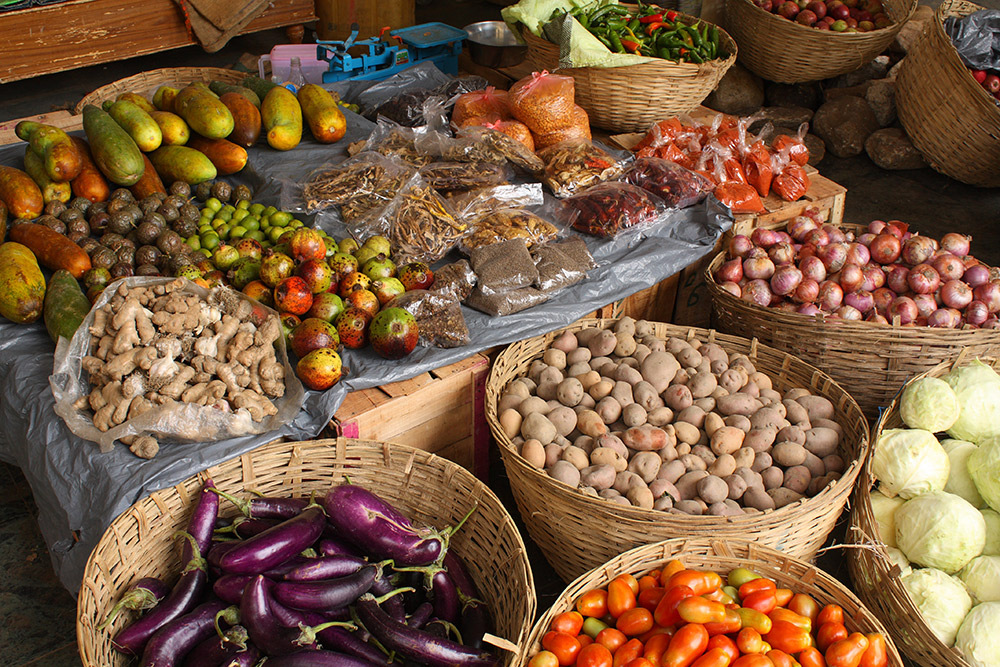
Heaps of rice were piled sky high in the market, alongside sacks of potatoes and stacks of cheese. As Sangay explained, farming is the mainstay of sustenance in Bhutan and the Bhutanese diet is largely composed of crops they grow and dairy products from their livestock. Rice, therefore, is consumed at every meal, with red rice being the most popular option as it's the only variety to grow at high altitudes.

Chili is a staple in Bhutan. Photo courtesy United Nations Photo.

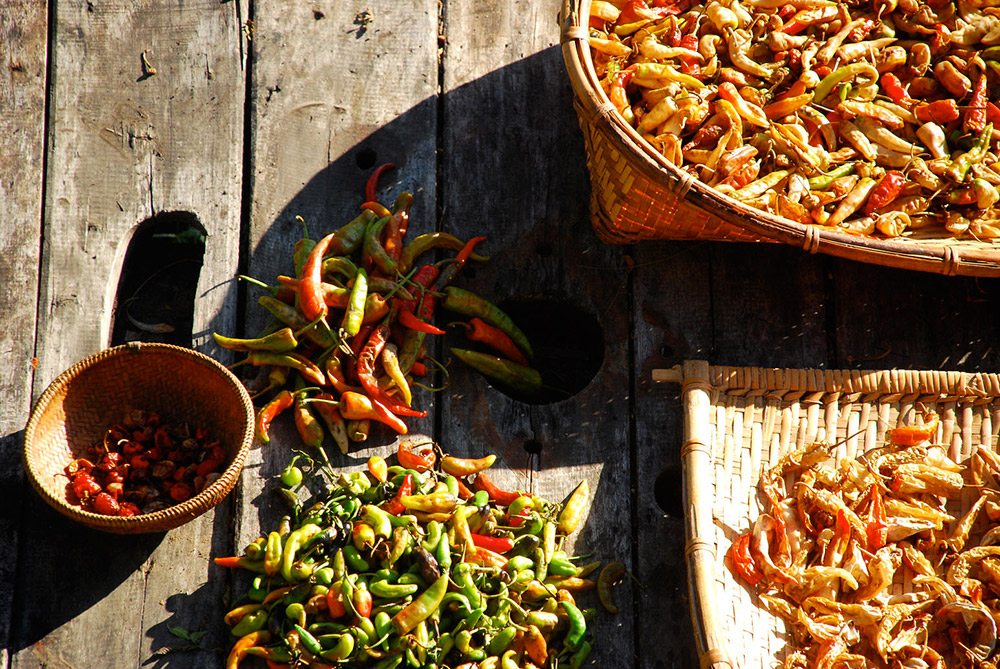
Chili is a main staple in Bhutan. Photo courtesy United Nations Photo.

Not surprisingly, the most common product found in the market was chili. The variety of chilies was mind-boggling: red, green, fleshy, slender, round, dried, blanched, powdered, and pickled. In various forms and species, they hailed from different parts of central and western Bhutan.

Strangely enough, chilies are not indigenous to Bhutan. As Sangay explained, chili probably came to his nation through India, and became an integral part of the Bhutanese diet because it was a natural way to stay warm in winter. Back in those days when they didn't have any proper heating systems for houses, spicy meals were an easy option.

Chilies also hold importance in Bhutanese rituals outside the kitchen. "From time to time, every house burns some chilies to keep the bad spirits or the demons away," he said.

That evening, Sangay and I drank a round of ara, a local rice wine. And guess what was floating in the transparent firewater? A trio of red piping chilies.

Goods sold at the Thimphu market. Photo courtesy Yoshihisa M.

Dried goods sold at the Thimphu market. Photo courtesy Yoshihisa M.

Local culinary traditions

Back in Paro, Sangay brought me to a farmhouse just a few kilometres outside of town to join Ama Om in her kitchen. When we arrived, she was already cooking up a storm, frying up tender chunks of beef with a handful of dried chilies, and melting down blocks of yak cheese. The aroma of fresh, steamed rice and pungent chili permeated the air.

The gregarious 60-year-old Ama Om told me that the meal she was preparing today was the classic Bhutanese grub she'd eaten since childhood. She had learned the recipes from her mother, who had in turn inherited them from her own mother.

Ama Om showing me the ropes in her kitchen.

Ama Om showing me the ropes in her kitchen.

When it came to culinary traditions, few things in Bhutan have changed. All the vegetables that they cooked in the kitchen were still grown in their garden, and the meat was from animals they reared.

As we sat down at the table with Ama Om and her family, a round of salted butter tea, or sura, was served. This ubiquitous drink is extremely popular in the high-altitude Himalayan region (including Tibet and Nepal), and often drunk with every meal.

Preparing to tuck in, Ama Om showed me the way they usually eat at home: with nothing else but their hands. Eager to fit in, I carefully scooped up a ball of rice with my fingers and kneaded some beef and a big slice of red chili in before swallowing it all in one gulp.

Home-cooked beef with chili.

Home-cooked beef with chili.

The explosive heat caught me by surprise, and spice-provoked tears streamed down my face; but just like the Bhutanese, I wouldn't have it any other way.

As my journey in Bhutan came to an end, I never quite put my finger on the reason why the Bhutanese are such a happy bunch, but one thing is for sure, food definitely has a part to play.

Getting There

G Adventures runs a number of departures in Bhutan encompassing a wide range of departure dates and activities to cater to different tastes. We're thrilled at the prospect of showing you this big blue planet of ours — check out our small group trips here.


Source: A culinary journey to Bhutan

Tuesday, 21 February 2017

Suggestions on food/snacks to pack when travelling with celiac to Japan

My husband and I are traveling to Japan in a few months. He has celiac disease. Due to the prevalence of gluten in Japanese food, we anticipate not being able to eat out much, if at all. What are some food items that are easy to bring along and eat, assuming we have access to very basic cooking facilities?

I've read a lot of blogs about traveling in Japan with celiac disease and the more I read, the more difficult it seems eating out in Japan will be. Gluten seems to be everywhere from the more obvious stuff like bread and cakes to more surprising things like soy sauce and some teas. Even things like edamame (which are naturally gluten-free) are sometimes boiled in the same water used to boil noodles, so the risk of unknowingly eating something that is cross contaminated with gluten is very high. We will be carrying a travel card like this to help explain what foods are dangerous to eat to restaurant staff, but we don't anticipate it making eating out completely safe.

We will be staying in various cities across Japan for about two weeks and will most likely be renting small apartment AirBnBs for a couple of days at a time, so we will have access to a kitchen. However, as apartments in Japan are so small, kitchens often consist of...a sink and a hot plate :)

We don't really want to eat protein bars for 14 days haha, so I'd really love any suggestions on things to pack. Obviously, nuts/trail mix, the aforementioned protein bars, and even a loaf of Scharr's gluten free bread (which unlike other gf breads, doesn't require refrigeration) are already on my list. We should have access to grocery stores for things like produce. (But since celiac is so rare in Asian countries, the store will be unlikely to carry specialty gf items, like bread.) I will also probably pack some gf instant noodles.

Thank you for your suggestions!


Source: Suggestions on food/snacks to pack when travelling with celiac to Japan

Monday, 20 February 2017

2016/7 FOOD & TRAVEL BAHRAIN AWARDS – GALA CEREMONY

After another incredible year, and the enormous success of last year's inaugural Bahrain Food and Travel Awards, this Wednesday (February 22) sees the Gala Awards and Ceremony at the InterContinental Regency in Manama.

Once again the Bahrain Tourism & Exhibitions Authority (BTEA) teamed up with Food and Travel Magazine to deliver the ultimate standard for Awards in the Kingdom.

More hotels, restaurants and establishments participated in this year's awards than ever before and the support from Bahrain has been unprecedented, with over 120,000 votes cast for the 2016/7 award – almost double the number from last year.

HE Minister Zayed Al Zayani & Four Seasons Team Winners Best Hotel 2015

Voters chose from category shortlists prepared by the Food & Travel Expert Panel, from literally thousands of nominations, selecting the best hotels, restaurants, and specialist retailers; from international brands & celebrated chefs to fantastic Bahraini initiatives and spectacular local talent, who made up the voting round of this year's Bahrain Food & Travel Awards.

"The discerning public have made their voices heard, selecting an elite band of finalists; ensuring the 2016/7 Bahrain Food & Travel Awards genuinely reflect not only public opinion but expert judgement too; a testament to the depth and quality of the nation's flourishing hospitality industry, confirming Bahrain's place on the culinary and tourism map." said H.E Shaikh Khaled bin Humood Al Khalifa CEO of Bahrain Tourism & Exhibitions Authority. "The Gala Dinner at the InterContinental Regency on Wednesday will be our most exciting Awards yet!" he concluded.

Salah Alhaiki Publisher Anisa Al Hawaj Editor HE Minister Zayed Al Zayan.

"Over the last few months our expert panel have made multiple incognito visits to each finalist, to not only assess quality but also consistency and service, ensuring the Bahrain Food & Travel Awards remain the most prestigious and sought-after awards in the region." added Salah Alhaiki, Publisher of Food and Travel Arabia.

Visit the Bahrain Food and Travel Awards web site at bahraintourismawards.com to see the elite group of that has made it through to the final round to be judged by the expert panel.


Source: 2016/7 FOOD & TRAVEL BAHRAIN AWARDS – GALA CEREMONY

Sunday, 19 February 2017

Insider travel tips: How to get ahead before take-off

Whether you're an international jetsetter, running a small interstate company or a millennial entrepreneur, business travellers have a million things to think about before they set foot on the plane.

From scoring premium travel upgrades to beating jet lag so you can ace that early morning presentation, there are so many things to take care of. Thankfully there are dozens of easy ways to make life on the go better and a much more enjoyable experience. Joining a rewards program like Qantas Business Rewards can also make your business spend and travel more rewarding.

A great way to make travel more efficient and maximise the experience is to think of it as a three-part plan. The time you spend on planning before your trip, time in the air and after you land.

Part 1: before you goTravel for business can be a lot more rewarding if you know how to use travel loyalty programs like Qantas Frequent Flyer and Qantas Business Rewards.

The obvious first task is to look at your Qantas Points balance to see how many points are in your account. It is possible to get extra comforts at little or no cost. One of the best ways to use points is for upgrades, which is good business practice to optimise your return on investment and value from a program. Or, if your travel budget is tight and you have enough points, use them for the whole trip – including flights and hotel bookings. Don't forget, there are some great deals on offer if you book early, including access to exclusive savings on Qantas flights as long as your business is a member of Qantas Business Rewards (it's free to join this month).

Of course, by choosing partners such as Qantas, Avis or Budget and Crown when you travel, you're maximising your points-earn opportunities as you'll earn points not only for the traveller but also for the business.

Surprisingly, it's the little things that can add up to a lot of savings for the business. Often we don't realise that our everyday business spend can go a long way towards extra benefits. For instance, if you're a member of Qantas Business Rewards and you spend with any of their partners or use a linked credit card, you could be accruing points on your business spend. So it's best to review how your business is spending and with whom, so every time you pay your bills, rent a car, book accommodation, book flights or even fill up on fuel, you're earning points.

Keeping track of your points balance and taking advantage of bonuses and other offers means that you'll quickly have enough points for flights and upgrades.

A good last tip is to think about global roaming charges if travelling overseas. There are great plans out there with minimal additional costs, like Vodafone's $5 roaming offer which brings peace of mind and up to 15,000 points to your business' account.

Part 2: when you travelThe airport can be one of the most stressful parts of the trip and it's best to get to the airport early for check-in. If you can, sort out your seating before you arrive and make sure you've packed within the limit. Many savvy business travellers join lounge programs to take advantage of the great facilities on offer and use it as their second office. With Qantas Business Rewards, members can get access to a 10% discount on 1, 2 and 4 year Qantas Club membership options, so if you travel frequently, that's another benefit you might want to consider.

If you're flying overseas, one of the easiest things once you are on the plane, is to adjust your watch to your destination time zone. This helps condition your body clock to get used to the new schedule. It's an easy an effective way to beat jet lag.

Don't forget – one glass of wine may help you get some sleep, but one too many will only give you a hangover. The same goes for the food. Keep it light and don't fill up with unnecessary carbs. If you are vegetarian or have a food allergy don't forget it is possible to request special meals with good airlines before your flight.

And while you're relaxing watching your favourite movie, reading your latest novel or getting some much needed quiet time to prepare for the next meeting, you'll be happy to know you're being rewarded twice just for being on board as a Qantas Frequent Flyer and a Qantas Business Rewards member.

Part 3: after you landIf you're travelling on a long haul flight and have time for a power nap at the hotel before a big meeting, then set the alarm on your smartphone or call reception to ask for a wakeup call. Jump in the shower or in the hotel pool to wake you up and keep you alert for early meetings.

If you don't have time to check in to the hotel or if you're just in town for the day be sure to take toiletries such as toothbrush, toothpaste, face wash and deodorant so you can freshen up before you meeting.

7 insider travel hacks for the business traveller1. Never exchange currency at the airport. That's generally the worst rate you'll get and whether you're on a company account or spending out of your own pocket, you can save a lot by shopping around to find the best rate. If you don't have time to research, simply go to your bank or do a quick scan on your smartphone to save.

2. Take advantage of pre-seating and options to get extra room when you can.

3. If possible, select an aisle or window seat in a row with only three seats. You'll either have a great view or easy access to the aisle. You're also more likely to have an empty seat next to you which can be hugely beneficial when you want to arrive in good shape for a big meeting.

4. If you're travelling for four days or less, try and pack everything in a carry-on luggage. This saves heaps of time waiting at baggage carousels and means you'll never lose your bags. Don't forget to always pack a spare change of clothes in your carry-on bag to stay comfortable on a long flight. This means you'll also have backup clothes in case your luggage is delayed.

5. It pays to be loyal: gather enough points to take advantage of the valid perks and upgrades on your travels. Take advantage of special offers such as free membership for Qantas Business Rewards program during February and earn Qantas Points every time you fly for business plus earn points for your business expenses.

6. Check if your credit card includes a concierge service. This can help you on things such as hotel discounts and upgrades, restaurant bookings and car rentals.

7. Download the app for your airline and loyalty program. It really helps if you can easily track your points, membership status and eligibility for different privileges.

WIN! Be 1 of 3 to win 100,000 Qantas points


Source: Insider travel tips: How to get ahead before take-off

Saturday, 18 February 2017

There’s time travel in a vertical wine tasting

Some wine lovers revel in older vintages of rare, expensive wines. They line up the bottles from each bacchanal like trophies and post photos on Instagram, Facebook and wine collector apps such as Delectable and Vivino. There's typically a self-congratulatory note to these posts. Wine lovers do like to share, but we enjoy bragging, too.

Such events can be fascinating. At a recent dinner at Ripple restaurant in Cleveland Park organized by wine writer Panos Kakaviatos, I was able to taste 16 vintages of Château Montrose dating to 1970. Montrose is in Saint-Estèphe, the northernmost appellation on Bordeaux's left bank, within spitting distance of the Gironde River. I visited two years ago, when Montrose hosted the Fête de la Fleur, a black-tie gala during the biennial Vinexpo trade fair. The Ripple dinner was more intimate, and it gave me and about 40 other oenophiliacs a chance to experience Montrose's unique expression over time while also getting to know the winery's chief executive, Hervé Berland.

The wines were postcards from time. We enjoyed second-guessing the winemaker's decision to harvest early in 1986, yielding a green-tasting, under-ripe wine, while praising the same decision in the warmer, riper year of 1976, when picking later might have been disastrous. I was pleased to record in my Moleskine that the wine harvested a few months after my wedding is drinking beautifully after more than three decades. And the vintage of my teenage daughter's birth is, like her, maturing into a beautiful and promising adulthood. As Kakaviatos said: "It's just entering its drinking window. Five years ago it was tough as nails." (And five years ago I would have told you what vintages those were. But in this day and age of protecting one's personally identifiable information, I'll leave you guessing.)

There's much to be said for opening one fine vintage and enjoying it over the course of an evening, rather than glugging a taste and rushing on to the next one, but I recommend a "vertical" tasting like this for its educational value for collectors and wine students alike. As one of my fellow diners, who has several vintages of Montrose in his cellar, remarked, "I enjoy each wine less this way, but I learn more."

A vertical tasting is time travel, but wine can take us to faraway places as well. Bulgaria, Turkey, Georgia and Armenia have appeared frequently in my recommendations over the past several months. These are not new wine regions by any stretch, but they have improved dramatically in modern winemaking. Many of the wines I've tasted follow a similar model: They feature indigenous (and often unpronounceable) grape varieties blended with international varieties, such as cabernet sauvignon or syrah. This combines authenticity and novelty with familiarity. Hiring a famous international wine consultant such as Michel Rolland or Paul Hobbs doesn't hurt, either.

My corkscrew travels have recently taken me back to Australia, which pretty much disappeared — aside from the ubiquitous Yellow Tail brand — from U.S. retail shelves after a torrid love affair in the 1990s. And we're missing a lot by ignoring Australia. Many Aussie winemakers are steering away from the ultra-ripe, jammy, high-alcohol shiraz reds that once defined Australian wine. They are following the model of the great syrahs of the northern Rhone Valley in France rather than a "bigger is better" philosophy. The best, like the elegant and delicious Shaw + Smith 2014 Shiraz from the Adelaide Hills region, retain some of the spicy raspberry character that says Australia without the excess that made the old style tiresome. These wines are often riveting.

And of course, Australia offers much more than shiraz. Pinot noir and chardonnay can also be exceptional, and winemakers are developing a distinct style with those grapes, a style on the lighter side, with bright acidity and never too much oak.

"In the early days, we were making pinot for shiraz drinkers," says Michael Hill Smith, a master of wine who founded Shaw + Smith winery in 1989 with his cousin, Martin Shaw. "Today, we are not afraid of wines that are lighter in color and body and more aromatic."

Smith was speaking at last summer's International Pinot Noir Celebration in Oregon, where he also presented the astounding pinot noir from Tolpuddle Vineyard in Tasmania. He and Shaw bought the vineyard in 2011, just as Tasmania was beginning to build a reputation for exceptional pinot noir and chardonnay. Fans of the "West Sonoma Coast" area in California should seek out the wines of Tasmania. They are hard to find, and not cheap. But they are less expensive than a plane ticket.


Source: There's time travel in a vertical wine tasting

Friday, 17 February 2017

What It's Like to Travel to Iran

Sheikh-Lotfolloah Mosque in Esfahan; Photo by Chris Nielsen Sheikh-Lotfolloah Mosque in Esfahan; Photo by Chris Nielsen

Chances are, when you tell people that you've booked an exotic trip of a lifetime, and that it's not a safari in Africa or island hopping in Thailand, but Iran, you might be faced with a rapid-fire line of questions and comments that express surprise, confusion, or both. 

After all, the second-largest country in the Middle East is no stranger to world news headlines, from the Iran nuclear deal to the ballistic missile test. It was also recently one of seven countries that was included in Trump's travel ban, which has been lifted for now. But politics aside, what is Iran really like? Travel guides highlight the country's beautiful landscape, architectural gems like Esfahan's mosques and Tehran's palaces, and heritage sites like the ruins of Persepolis. Still, the politically and culturally complex country remains a mystery to many. Even the well-traveled Anthony Bourdain said in a recent "Parts Unknown" episode, "Iran does not look, does not feel the way I'd expected." To clear things up, we spoke with a handful of travelers who visited the country within the last year or so. Here's what they had to say.

The locals are very friendly. A man and his Qurans at the Tomb of Hafez in Shiraz; Photo by Chris Nielsen A man and his Qurans at the Tomb of Hafez in Shiraz; Photo by Chris Nielsen

"Despite what one reads in the newspapers and hears on TV, Iranians are a friendly and outgoing people. We had many instances during our travels when young Iranians would approach us and ask: 'where are you from?,' 'what do you think of Iran and Iranians?,' and 'what is America like?' Many young women and school girls were particularly friendly, and asked if we liked wearing scarves. We replied by saying it was difficult to get used to having a head covering on at all times and many replied that they didn't like to wear them either." — Nicole Beattie, visited November 2016

"We would often have people come up to talk to us. We didn't do dinners with our group tour, so we were free to do what we wanted at night. My wife and I would often walk from our hotel and explore. That's when we'd talk to locals. People were very friendly and warm and overall curious about us. They would often assume we were French or German, because they get a lot of tourists from there. When you explain that you're American, they would often lead with the same question: 'what do you think of Iran and the Iranian people?' Every single interaction we had was positive. As you pass women on the sidewalk, they would say 'thank you for visiting Iran' without having said anything to them. You also have a lot of men who would put their hand across their heart as a sign of respect when you walk through places. Even when people couldn't communicate with you in English, their body language would communicate that you're welcome here." — Chris Nielsen, visited October 2016

"Many Iranians speak English, especially in Tehran and Esfahan, so interacting was easy. Iranians love tourists and are always very helpful. My visit was very relaxed and a lot of fun. Western media tends to portray Iranians as backward and hostile, and they are nothing of the kind. Iranians are well-educated, highly tech-savvy, cosmopolitan, funny, relaxed, friendly, and extremely hospitable. Whatever you think of the Iranian government, it has nothing to do with the Iranian people. They are absolutely lovely and very welcoming to visitors from all parts of the world, especially the West. [One day] we were stopped at a gas station and there was a lot of commotion and wrangling over fuel ration cards. In Farsi, I asked a truck driver standing nearby what was going on. At first, he looked at me like I had spoken Martian, but when I asked again and he understood that I was indeed speaking his language, he was all smiles. His face lit up. We chatted for a minute or so and then he cli mbed into the back of his truck, which was full of watermelons. He picked through them and came back with a beautiful fruit. He gave it to me as a thanks for showing him and his country respect and admiration. I'll never forget it." — Cynthia DeKay, visited May 2012 and July 2016

And separate the U.S. government from the American people. Photo by Cynthia DeKay Photo by Cynthia DeKay

"Because of historical hostilities between the United States and Iran, I would have thought that Iranian people would not like Americans. I found the opposite to be true—they were very curious and interested in Americans. Most of the people we met said they would like to travel to the U.S. I think part of this has to do with how people in Iran experience politics. In that part of the world, the people experienced a kind of 'arbitrary government' that was unstable and beyond their control. Even now, the people do not always feel that the results of the elections reflect how they feel or how they voted. The result of this is that Iranian people don't view their government or the politics of their country as a part of their identity the way that Americans and Europeans do. They can dislike the American government, but have nothing against the American people. I was similarly surprised when I talked to them about their feelings about Iraqi people. The Iran-Iraq war raged for eight years in the 1980s and wiped out an entire generation of young Iranian men (estimated to be about one million) with really no benefit to either side. Yet the people we talked to said they had no animus towards Iraqi people. They see the actions of the government as separate from the people. I was incredibly saddened when I heard about travel ban enacted by the U.S. government towards Iranians, and the retaliatory travel ban by Iran towards Americans. I thought of all those people in Iran who are so hopeful to visit the United States and eager to make connections to the outside world. But their opportunities are limited by arbitrary politics, completely beyond their control. I hope that they continue to see the American people as separate from the government because it makes me even more sad to think they might believe the travel ban is what most Americans want." — Esther Hui, visited April 2016

"I was surprised at how safe I felt. People in Iran are so helpful and kind to visitors. Street crime is minimal compared to other places I have traveled—even in Europe. I think Americans feel like they would be in some kind of extra danger due to the strained political relations, but I didn't feel that at all. In fact, quite the opposite—Iranians love to talk to Americans. They almost always made a point to emphasize that any political problems were between the governments, not the people." — Cynthia DeKay

Home-cooked meals are better than food at restaurants. Nomadic woman making bread; Photo by Esther Hui Nomadic woman making bread; Photo by Esther Hui

"Intrepid tours are great for interacting with locals because they plan several evenings where you are either eating dinner with a local family or even spending the night with them. There were some great things that came from this. First, the food was very good. We had heard that the best Persian food comes from people's homes, not restaurants. Our tour guide explained to us that there is not a restaurant culture in Iran, and that you cannot easily get many of the things that are typically prepared in homes at a restaurant. We had some incredible meals. The most memorable one was with the nomadic family. The matriarch of the family prepared an apricot chicken and Persian rice. She made a type of flatbread in a cast-iron pan—each flatbread was made individually over an open fire. The other thing that was great about these meals was that we could learn more about what people's lives were like. Often the older people (preparing the food) did not speak English, but their adul t children would come to the meal to talk with us. It was during these evenings that I learned about Iranian politics, economy, and education; what it was like for women; how things had changed in the past 20 years; and people's hopes for the future." — Esther Hui

"My wife loves to eat when we travel—especially street food—and she was disappointed that there weren't many street food options. It also felt like every restaurant we went to had the same thing on the menu, and tasted the same. The restaurants are predetermined by the travel coordinator, so maybe they thought that's where Americans wanted to go. It's going to be a long time before either of us can eat kebabs again, though." — Chris Neilsen

It's home to ancient caravanserais. On the roof of the caravanaseri; Photo by Andrew Wind On the roof of the caravanaseri; Photo by Andrew Wind

"My favorite night was the one we spent at an ancient caravanserai, which had been converted into a hotel, in the middle of the desert. Caravanserais are like medieval pit stops where you can spend the night, get food, and trade goods, while traversing the ancient Silk Road. They were spaced 60 kilometers apart. Because it was so isolated, and because the caravanserai itself was considered private property, I was allowed to be outside without a head scarf, or hijab. In Iran women must keep their head covered in all public places, including when they are in private buses (because they can be seen through the windows). I sat on the roof of the caravanserai and read my book for a few hours. The only thing I could see in every direction was sand. It was glorious." — Esther Hui

And plenty of other gorgeous highlights. Inside a mosque; Photo by Esther Hui Inside a mosque; Photo by Esther Hui

"The Ali Qapu palace and Vank Cathedral in Esfahan, the tower of silence in Yazd, Zein-o-Din caravanserai, Faloodeh-Shirazi (do not miss this frozen treat when in Shiraz—there's no better, tastier way to beat the heat!), the nature bridge (Pol-e Tabiat) in Tehran, watching the sunset from a rooftop in Yazd, and chilling on a rug eating fesenjoon (chicken and pomegranate stew) and drinking tea. I could go on forever..." — Cynthia DeKay

"From its mirror-encrusted Golestan Palace to its vast, vacant desert landscape and barren mountains, Iran's history and monuments take one's breath away. Our trip was a custom itinerary created by Corinthian Travel. Some of my favorite not-to-be-missed sights include Tehran's famed Carpet Museum. Its facade resembles a carpet-weaving loom, and inside, there's a collection dating from the third to fifth centuries A.D. One should not miss the Reza Abbasi Museum in Tehran, which has a stunning collection of Persian art dating back to the second millennium B.C. [There's also] Persepolis, the ceremonial capital of the Achaemenid Empire, with the remains of its colossal buildings and dark gray marble pillars standing in silent tribute to a glorious past. My personal favorite is the Jewels Museum, home to the Imperial Crown Jewels of Iran. Here is the most dazzling collection of tiaras, aigrettes, jewel-encrusted crowns, bowls filled with uncut diamonds, emeralds, rubies, and sapphir es. A unique piece in this collection is a large globe, with its oceans made of emeralds and continents made of diamonds and rubies. Of course, the prize jewel is the Daria-i-Noor, a pink diamond weighing an estimated 182 carats. Its pink color is considered one of the rarest ever found!" — Nicole Beattie

Esfahan is not to be missed. Si-o-Seh Pol Bridge in Esfahan; Photo by Chris Nielsen Si-o-Seh Pol Bridge in Esfahan; Photo by Chris Nielsen

"Another highlight was the city of Esfahan. It is one of the few historical cities in Iran which was has not sustained significant damage from war, earthquakes, or the Mongolian raids in the 13th century. In addition, it was the capital of the Persian empire during my favorite architectural period, that of the the Safavids. It is magnificent. There are beautiful hotels and gardens in Esfahan. They also have a series of bridges along the river that are lit up at night. The oldest of these bridges has pre-Islamic foundations." — Esther Hui 

"Esfahan was our favorite city. It's regarded as a city that has more of an artistic culture. Some of the mosques there are really cool. That's where they have some of the best blue-tiled ceilings." — Chris Nielsen

95 percent of the world's saffron comes from Iran.

"I love saffron, but have had very little of it in my life because it is so expensive. You can buy a tiny container at the grocery store for $10 and that's enough for maybe one or two recipes. What I found out on this trip is that 95 percent of the world's saffron comes from Iran. Because of the embargo, this cannot be imported into the U.S. So any saffron you buy in the U.S. comes from the other 5 percent produced outside of Iran. This is why it is so expensive! In Iran, saffron is everywhere. It is a featured ingredient in many dishes. But the surprise we came upon early in the trip was saffron ice cream. It was so unusual and refereshing. After I had it for the first time, I tried to have some every day. You could get scoops at ice cream stores and saffron ice cream sandwiches in many shops. I bought two packages of saffron in the open market which I brought back with me. They cost about $9, but both contain the equivalent of about $150 worth of saffron if I were to bu y it in the U.S. I wish I'd bought more, but I was concerned it would be confiscated at customs, so I didn't want to risk it. My friend Andrew, who I traveled to Iran with, has made homemade saffron ice cream since we got back. This is a wonderful treat." — Esther Hui

There's anti-American propaganda, but Iranians aren't anti Americans.

"We only saw anti-American propaganda twice—and once was at the embassy in Tehran, which everyone knows about. We were in the public square in Esfahan and saw some propaganda on banners. Iranian people would see us taking pictures of it and come up to us. After talking to them, you'd learn that they see it a different way. Iranians often told us that they love America, American people, and the culture, but just don't understand American policy. They would say they don't understand what the American government is doing and why they don't like Iran. Other countries are good at separating people from policy, so it was a relief to hear them say that. It was weird to be standing under these propaganda banners, and hear them say 'that doesn't mean what you think it means. We don't think of it that way.' That was an interesting takeaway." — Chris Nielsen

Women have to wear headscarves.

"Every woman was wearing a headscarf. It still seemed to be very conservative in that way. Women had to cover up the whole time they were there. Guys just had to wear long pants." — Chris Nielsen

You can visit a mosque, even if there's a prayer going on. Photo courtesy of Chris Nielsen Photo courtesy of Chris Nielsen

"You are free to go in the mosques, even if prayers are happening at the time. We were in one mosque where 50 men were praying. We were in the corner, and it was fine, which surprised everyone. We thought none of us would be able to stay in there. Iranian women have to go to a different area, but they allowed our whole group to be there." — Chris Nielsen

The process for getting a visa can be tough.

"To get our travel visa, the first thing we had to was submit was an application and resume—we did this through our tour. Then, you have to submit your passport to the Pakistani embassy in D.C. (they have a desk for Iran tourism there). Once they clear you, they put your visa in your passport and send it back to you. You have to pass through their application process." — Chris Nielsen

"I had wanted to go to Iran for over 10 years. I am generally very interested in the Middle East, but Iran is not an easy place to get to. It's expensive, the visa process is complicated (because of recent events, Iran is currently not issuing visas to Americans at all), very few tours go there, and sometimes the political climate makes it difficult. I tried to plan a trip there five years ago, but things were not stable. Ironically, I opted to go to Syria instead, because at the time, it was considered safer. The planning for this trip started eight months in advance, and there was a lot of stress leading up to it, because I worried at any moment something would happen to keep us from going. Even when we got off the plane in Tehran, we were pulled aside by the border control because we were Americans, and I had a moment of panic. But Iran did not disappoint in any way. It was everything I hoped it would be. The food was very good and the sights were incredible. This include s ancient ruins (Persepolis), architecture in the cities from the past few hundred years, and the beautiful mosques. My friend Andrew and I both bought Persian rugs in Esfahan.  I treasure these memories and experiences. I had dreamed for so long of going there and I feel it is unlikely I will be able to go back." — Esther Hui

Editor's note: U.S. citizens can travel on a visa, but need to go with a group tour or private guide. Obtaining a visa can also be a challenge. It's advised to start the process months in advance. Travel itineraries must be approved before being issued a visa, but your tour operator or agency will guide you through the process of submitting an itinerary and visa application. 

Keep in mind that the U.S. has a travel warning for Americans headed to the country. It's important to note that possession of a valid Iranian visa will also not guarantee entry into the country. Iranian authorities have prevented a number of U.S. citizen academics, scientists, journalists, and others who have traveled to Iran from leaving the country, and in some cases have detained, interrogated, and imprisoned them on unknown or various charges. U.S. citizens can find more information here.

Iran has also stated that it would prevent U.S. citizens from entering the country as a retaliation to President Trump's travel ban against Iran and six other Muslim-majority countries. We recommend checking the U.S. Department of State website for any updates when planning a trip.

You might experience color shock. Northeastern Iran, near the Turkmenistan border; Photo by Cynthia DeKay Northeastern Iran, near the Turkmenistan border; Photo by Cynthia DeKay

"Overall, there was a lack of color, starting from the architecture and buildings to cars and people's dress. There are very muted tones, so a lot of browns, blacks, and grays. Iran's been in a pretty significant drought, so all the river beds we encountered were dry. Vegetation seemed very brown. That was something we all noticed right away. At a certain point, that begins to see like the norm until we flew back to Seattle, which is obviously very green. When we came back to Denver, it was fall and there were a lot of colors—it was a shock to the system." — Chris Nielsen

Tehran has changed quite a bit in the last two years. Tehran; Photo by Chris Nielsen Tehran; Photo by Chris Nielsen

"To give you a little background about myself, I was born in Tehran and lived there for 23 years. I left the country for graduate school in United States. I went back to Iran after being away for over two years. When I went back, I was surprised to see how much Tehran had changed in just two years. Iran, especially Tehran, is developing so fast. On every street, you see new construction and development. I was surprised by the number of new highways, bridges, parks, and high-rises. I had missed so much—it was like I hadn't been there for 10 or 15 years." — Ali Shahabi, visited August 2016

There's always more to see. Fin Garden, Kashan; Photo by Nicole Beattie Fin Garden, Kashan; Photo by Nicole Beattie

"[If I went back], I would want to see the crown jewels at the Treasury of National Jewels in Tehran. It is only open for a few hours a day, a few days a week. Unfortunately, we weren't able to make it when they were open. There are supposedly some breathtaking crowns and beautiful emerald necklaces. I was disappointed to miss this." — Esther Hui

"There are so many things I still want to see in Iran, but if I have to choose one, it would have to be visiting the Caspian Sea and the lush, mountainous landscape that borders it." — Cynthia DeKay

"I would be really interested to see how the landscape looks when they're not in having a drought. You could see the potential of how beautiful it could be if things were green and if there was actually water. They have a lot of water features—botanic gardens and hotels are often trying to showcase water—but when you're there during a drought, it's limited. The second thing I'd like to do is go into someone's home and see what a typical home looks like. We weren't able to do that. That's one experience I feel like we missed." — Chris Nielsen

You'll Also Like: 


Source: What It's Like to Travel to Iran

Thursday, 16 February 2017

'Bon Appetit' awards LA's healthy food scene, overlooking that 1.5M are food insecure

Those looking for a great place to eat healthy need look no further than Los Angeles — if they can afford it. 

On Monday, Bon Appetit named Los Angeles the "most healthyish city in America" for its array of avocado-laden and heavily vegan menus throughout the city. 

"Whatever other insults you want to lob at Los Angeles ... the truth is that this town has healthy yet insanely delicious food in the bag," Bon Appetit wrote. Among the 11 eateries profiled by the magazine include places that serve beet-sumac sodas and turmeric poached eggs. 

While the list is a nice menagerie of culinary hotspots, boasting about actors and actresses maintaining bodies like Jessica Alba's seems a little disconnected from the reality of what so many face when it comes to food in Los Angeles. 

Los Angeles' food desertsSource: USDA

According to the USDA, Los Angeles has several areas that would be considered food deserts, or areas where people lack access to fresh foods. While more wealthy areas in LA, like Beverly Hills, don't have any food deserts, places like East Los Angeles, Inglewood, Compton and Bell Gardens have quite a few. 

As local affiliate KCET pointed out, those areas of the city that contain food deserts are also the parts where obesity rates spike, because rather than access to fresh fruits and vegetables, residents in these areas can more easily access fast food or nutrient-void ingredients. 

The biggest impediment to obtaining food is actually structural racism. According to the 2012 study "Unshared Bounty," black Americans are half as likely to have access to fresh, healthy foods and Latinos are about a third as likely to have similar . Additionally, black, Latino and Native Americans living in low-income, minority communities have to travel farther and pay more for groceries. On average, grocery stores in these communities are also 2.5 times smaller than those in high-income communities. 

Los Angeles man obtaining groceries from a non-profitSource: Kevork Djansezian/Getty Images

Los Angeles county is home to the largest population of food-insecure people in the U.S, according to a 2015 study from Feeding America, the nation's largest domestic hunger-relief organization. Just under 1.5 million people, or 14.7% of the population, are considered food insecure, or lacking access to healthy food, at any time in LA. Nearly 600,000 children, or 1 in 4 children in LA, experience food insecurity. 

Source: Kevork Djansezian/Getty Images

Celebrating LA's mouthwatering food scene, complete with cocktails and appetizers that creep way beyond double digits in price, doesn't exactly fit a broad definition of healthy. Sure, it's healthy for the wealthy, but to label LA as having a healthy food scene and ignoring pretty widespread lack of access to health food is a dash irresponsible. If LA is the most "healthyish" city, that's light on the healthy and heavy on the "ish." 

No amount of high-end restaurants can replace the necessity of a grocery store with a good selection of fresh fruits and vegetables. So, while LA might have an ample selection of healthy menus, due to the structural racism behind food deserts, it might have some of the least healthy people.

Tn't the first time Bon Appetit has revealed a blindspot for racial issues. In September, the food publication caught heat when they released a video of a white chef explaining the (only) proper way to eat Vietnamese pho. 


Source: 'Bon Appetit' awards LA's healthy food scene, overlooking that 1.5M are food insecure

Tuesday, 14 February 2017

This Omelet Is How Anthony Bourdain Resets After Travel

Anthony Bourdain © Bobby Fisher Anthony BourdainBack when I used to stand on my feet and really work for a living, cooking and leading cooks in a series of kitchens of high and mostly low repute, I didn't actually prepare much food for myself. At the end of a long shift in a hot, loud kitchen, I preferred the restorative nutrition of a few beers and maybe a street meat sandwich or a greasy slice of pizza before heading home and slumping off to bed.

But once in a while, paradoxically after a particularly grueling night—say, New Year's Eve, Valentine's Day, or Mother's Day, surely among the busiest and most difficult days to work in restaurants—I'd do a hard reset the next day for breakfast by making myself a simple omelet, into which I'd cook julienned smoked salmon and chopped chives. I'd top it with sour cream and caviar, pour myself a cup of coffee or a glass of Champagne, and enjoy a perfect, solitary meal.

My professional cooking days are long behind me, and I now make a living largely on the road, always on my way to or from some far-flung location, to find out how to eat, how they live, and to make fun and creative television out of what I find with some of my best friends. My life has improved immensely from those days of dunking potatoes into hot oil for the nameless, faceless masses of hungry New Yorkers with more money than me—but my omelet breakfast ritual, though practiced somewhat more infrequently these days, remains the same.

After a week or more of cacophonous, spicy, unpredictable street food in Asia, or the best of Italy's pastas and cured meats, or the world's most lackluster hotel and airplane fare—or some combination thereof—I crave the simplicity and perfection of eggs, herbs, and fish. So once I'm home in my own apartment in New York, it feels necessary and right to make myself this omelet as a way to come down to earth for at least once meal. I run to the fancy grocery store for salmon and caviar, gather the eggs and butter and the rest, pull out the nonstick omelet pan, and reassert absolute control over what I'm eating, at least until the next taxi pulls up and I'm headed to the airport once again.

Now watch The best way to cook scrambled eggs — according to Anthony Bourdain:

Click to expand
  • The olive suit is the ultimate style upgrade

    This spring, add an olive suit to your tailored arsenal. It works well with every single skin tone and gives you a lot of options with shirts and ties.

  • Adele Stuns on the 2017 GRAMMYs Red Carpet in Gorgeous Green Gown -- Pics!

    The GRAMMY nominee basically shut down the GRAMMY red carpet in her stunning dress!

  • Grammy Fashions That Regular People Should Not Wear

    Some red carpet fashions inspire trends on main street. Here's hoping these fashion trends are not repeated. Keri Lumm (@thekerilumm) reports.

  • UP NEXT

    UP NEXT


    Source: This Omelet Is How Anthony Bourdain Resets After Travel

    Monday, 13 February 2017

    'Who wants pizza?': WestJet pilot buys food for stranded Air Canada passengers

    A statement from Air Canada said "we should have done better for our customers," after an employee told stranded passengers getting food delivered wasn't an option. Travis Pereira/CBC © Copyright: (C) Canadian Broadcasting Corporation, http://www.cbc.ca/aboutcbc/discover/termsofuse.htm... A statement from Air Canada said "we should have done better for our customers," after an employee told stranded passengers getting food delivered wasn't an option. Travis Pereira/CBC

    A WestJet pilot is earning high praise after paying for pizza for passengers that got re-routed while travelling to St. John's — on an Air Canada flight. 

    "There was outwards applause when it happened," says John Samms, who lives in St. John's.

    It started after an Air Canada plane couldn't land on Feb. 8 due to bad weather and ended up going back to Fredericton. 

    Samms said passengers were told by an Air Canada staff member in the airport at midnight that ultimately, it wasn't possible to get food delivered.

    "Out of nowhere, a WestJet pilot emerged and said, 'Hey ... I am from WestJet and we do things differently. Who wants pizza?'" Samms told CBC's St. John's Morning Show.

    "Within 20 minutes to half an hour the pizza had arrived and I think he paid for it out of his own pocket."

    Air Canada says sorry

    Samms said it was especially surprising, since all of the passengers were travelling on a competing airline. 

    "That was the irritating part for me ... I had taken it as perhaps a lack of effort on Air Canada staff, " said Samms, who had lived in Fredericton for a few years and knew there were at least a few pizza places open. 

    For its part, Air Canada is apologizing to customers for the incident, and acknowledging the efforts of the WestJet employee.

    "Unfortunately the food service was closed but thankfully, a caring customer, an airline employee himself, so truly empathetic to the situation, stepped up," Air Canada said in a statement provided to CBC News. 

    "Clearly we should have done better for our customers."

    Samms said no airline is perfect all the time, but people remember when staff go out of their way, especially for these passengers that weren't even flying with WestJet. 

    "A little bit of effort can go a long way when it comes to customer service."

    CBC News asked WestJet for comment and the mystery pilot's name, but had not heard from that airline as of Monday. 


    Source: 'Who wants pizza?': WestJet pilot buys food for stranded Air Canada passengers